Your risks, your controls, your audits. Connected, from the field to the boardroom.
Permanent control, Basel III, AML-CFT: obligations keep piling up, scattered across spreadsheets, emails and shared drives. A shared framework connects them, so you can manage risk proactively instead of simply reacting to it.
Every risk, every control and every obligation is tied to the same framework. No more conflicting versions across departments.
Every team contributes to the same risk map. Weak signals surface earlier, before they turn into problems.
From the field to the Executive Committee, data is consolidated, up to date and shared. Everyone talks about the same risk, at the same time.
Every control, every action and every incident is tracked in one place. Evidence is available when you need to present it, whether during an audit or a control review.
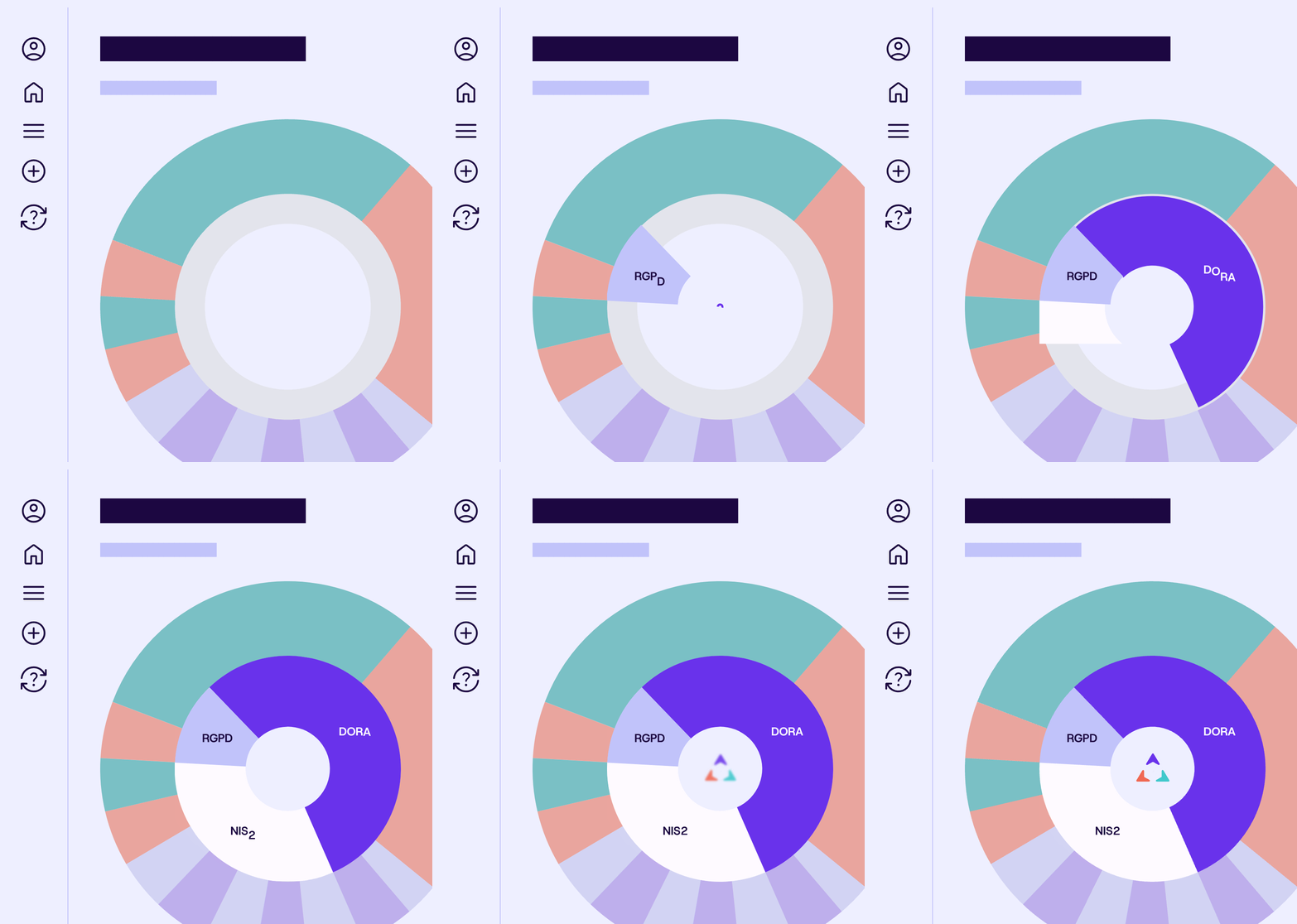
One shared framework, from the field to the boardroom.
Each module stays autonomous, but all share the same foundation. An incident updates the risk map. A control informs the audit. Data flows without re-keying. First line, second line, internal audit: three roles, one shared source of information.
From mid-market companies to large enterprises. They manage their risks with Delta RM.


Manage your risks, your controls and your audits. In a single platform.
Built with risk professionals, for daily use. Each function keeps its specific requirements while sharing a common framework.
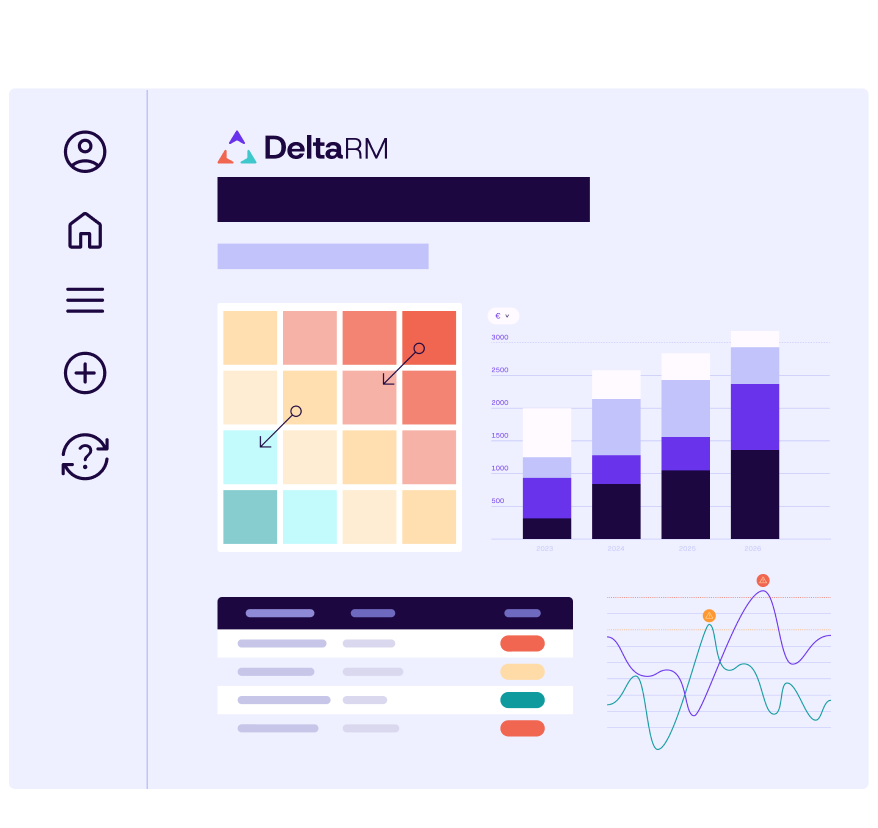
From risk mapping to steering, in a single tool.
From risk mapping to board reporting, everything rests on the same framework. Your teams contribute, control is demonstrated by facts, leadership decides with full visibility.
Dynamic heatmap, gross, net and target scoring in real time, multi-criteria assessment (probability, financial impact, ESG impact) and action plans linked to every risk.
Structure your control framework (first and second line), link it to risks and regulatory requirements (DORA, GDPR, NIS2), and run your self-assessment, testing and sampling campaigns. Automate ongoing control activities.
A risk-based audit plan, end-to-end audit management, recommendations turned into action plans with automatic reminders, and a portal for auditees.
Incidents can be reported easily from the field. Causes, impacts and actions are documented to understand what happened and prevent it from recurring. Every incident enriches the risk map.
Consolidated dashboards for the Risk Committee, the Audit Committee and the Executive Committee. Excel, PDF and PowerPoint exports, with no reformatting.
On your control and audit evidence, the AI agent checks completeness and consistency, scores each line and flags missing items. Sovereign, auditable, and designed to align with the EU AI Act.
How we structure your GRC framework.
In 3 steps.
Expert Scoping
We help you define scope, assessment criteria and taxonomies, before configuring the tool.
Collaborative Rollout
Scoping, configuration, training, go-live: we're there at every step. We stay with you until your teams have fully adopted the platform.
Continuous Monitoring
We support you in evolving your framework, enriching your data and demonstrating the value of GRC to the Executive Committee.
Start with one module.
Activate the others at your own pace.
That's collective GRC.
An incident linked to its risk. A control linked to its evidence. An audit informed by both.
That's collective GRC.
Link each control to the risks it covers. See in real time how your controls affect residual risk.
Prioritize your missions on the most critical risk areas. Each audit updates your risk profile and closes the loop between exposure and control.
Link each incident to a risk in your risk mapping. Detect weak signals. Act before it breaks.
Formalize your first- and second-line controls from your mapped risks. Measure the gap between gross and net risk.
They've transformed their permanent control processes with Delta RM.
Internal control leaders and teams who have moved from spreadsheets and paper files to a managed, auditable control framework connected to their actual risks.

Frequently asked questions from control and audit teams in the banking sector
The questions control and audit teams ask before choosing their GRC software.
RMIS (risk management information system), GRC (Governance, Risk & Compliance), eGRC and IRM are closely related terms for the same family of platforms, which centralize risks, controls, compliance and audit. For a bank or financial institution, Delta RM brings risk mapping, permanent control, periodic control and incidents together on a common base.
By linking permanent and periodic control to a shared risk framework: control campaigns (first and second line), audit missions, incidents and action plans all attach to it. Teams work on this same framework, structured according to your reference frameworks (COSO for control, IIA standards for audit), and reporting consolidates without re-keying.
Delta RM is framework-agnostic: its configurable structure can be adapted to ISO 31000, COSO, SOX, DORA or NIS2. In practice, you link your risks, controls, action plans and evidence to your applicable requirements. The platform is not meant to "make you compliant": it makes the traceability of work, controls and evidence easier, without replacing the institution's own responsibility.
Yes. Each entity manages its own scope, with consolidation at group level. The hierarchy goes up to 8 levels and access rights are granular: the group Risk Manager sees a cross-entity consolidation, while a subsidiary sees only its own scope.
No. Delta RM runs with no user limit. You pay for the platform, not for each employee. It's a deliberate choice: collective GRC cannot be held back by per-user billing.
Yes. Incidents are reported from the field, linked to risks and controls, and feed into the risk map.
Yes. Data is hosted in France on Scaleway's European cloud infrastructure. The Delta RM platform is ISO/IEC 27001 certified and its hosting is SecNumCloud-qualified. Delta RM is an independent software vendor.
Is a feature missing from your system?
Our roadmap is built with you. You express a need. If it's shared, it becomes a product priority.